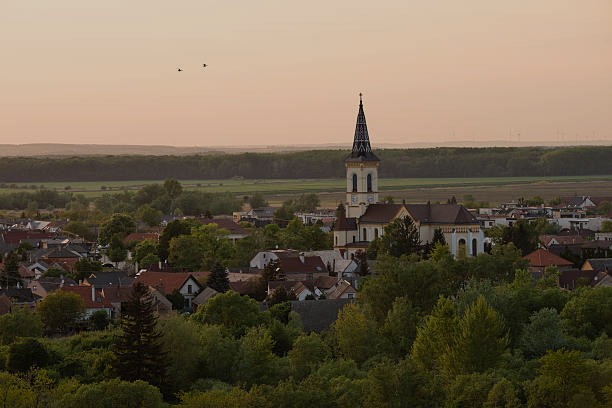
The town of Lozorno, Slovakia

Urban Infrastructure Consulting · Slovakia · Spring 2026

Lozorno Water Systems

Can a fast-growing Slovakian town's drinking water system support its growing population? Part of an infrastructure study commissioned by the town's mayor.

A growing commuter town running on a 1983 water network.

Lozorno is a town of about 3,600 people roughly 20 km from Bratislava, Slovakia's capital. As the capital's commuter belt expands, the town is growing, with large new housing developments already approved.

Its drinking water comes from three local wells and runs through a PVC distribution network built in 1983. The town reports falling water levels in its wells and has little in-house engineering capacity for long-term planning.

Our team of three co-authored the Sustainable Systems Integration Analysis, a study of Lozorno's infrastructure built on data from the mayor and PAVOS, the town's water operator. I was responsible for the drinking water analysis: the supply ceiling, 20-year demand, and three costed solutions.

Lozorno's distribution network (purple), supply line from the wells (blue), and the BVS regional main along the D2 motorway (yellow, approximate). Imagery © GKÚ, NLC

Comparing what the wells supply with what the town will need.

Working from municipal, regional, and national records, I started from the operator's own numbers: 194,573 m³ pumped per year against 152,877 m³ billed to customers. The difference showed how much the network loses, and the billing data gave household use of about 99 liters per person per day, in line with the Slovak average of 80 to 100.

Because well levels are already falling at today's pumping rate, I treated current pumping as the realistic supply ceiling rather than the much higher legal permit limit. I then projected demand to 2045 using our team's population model, sizing for the high-growth scenario since new infrastructure has to last for decades.

Approved Záhumenice housing development, a main driver of projected growth. Drawing: WhatArchitects, 2023

The system has no room left for growth.

Once losses are accounted for, meeting today's demand requires 194,494 m³ per year. The wells pump 194,573. That leaves a margin of 79 m³ per year, about enough for one more resident. The 750 m³ reservoir also falls about 50 m³ short of demand on a peak summer day.

22% of pumped water, about 41,700 m³ a year or roughly 17 Olympic swimming pools, never reaches a customer, against a 15% EU best-practice target. Because household use is already moderate, conservation alone cannot close the gap.

79 m³

Yearly margin left

Between current pumping and current demand, about enough for one more resident

22%

Water lost in the network

Roughly 17 Olympic pools a year, against a 15% EU best-practice target

2027

Supply exceeded, even with leak repairs

High-growth scenario. Without repairs the demand already equals supply

Projected annual shortfall, high-growth scenario (m³/year)

Year Residents Shortfall at current losses Shortfall with losses cut to 15%
20253,602014,718 surplus
20304,22933,77116,578
20354,52349,64631,258
20404,80464,81945,288
20455,05178,17757,620

Projected demand against the current supply ceiling, 2025 to 2045

Fix the leaks first, then add new supply.

I proposed three measures, phased so the cheapest and fastest come first.

1

Repair the distribution network

Bring losses from 22% to the 15% target, cutting the 2045 shortfall by about 20,500 m³/yr without drawing more from the wells.

€235k to €621k
2

Drill a new borehole

A modest 1 to 2 l/s well adding about 25,000 to 30,000 m³/yr, only after a hydrogeological survey confirms the aquifer can support it.

€131k to €269k
3

Connect to the regional water main

The BVS regional main already crosses Lozorno's land. A 530 m pipe through farmland would add about 30,000 to 35,000 m³/yr from a source independent of the local aquifer.

€205k to €407k

Phased from 2026 to 2035, the three measures add an estimated 75,500 to 85,500 m³/yr, roughly the size of the 78,000 m³/yr shortfall projected for 2045. Total cost is estimated at €571,000 to €1.3 million.

I charted a funding path for each measure through Program Slovensko 2021–2027, whose water supply call covers towns of over 2,000 residents like Lozorno. Because Lozorno lies in the Bratislava Region, which the EU classes as more developed, EU grants can cover at most 40% of eligible costs, not the 85% available in most of Slovakia. That leaves roughly €343,000 to €778,000 for Slovak state and municipal funding.

Two steps should start right away: a hydrogeological survey of the aquifer, and talks with BVS, since a connection takes 4 to 8 years to permit and build.

Proposed 530 m connection route to the BVS main. Imagery ©2026 Airbus, CNES / Airbus, Maxar Technologies, Map data ©2026 Google

Costs are planning-level estimates. The final connection point is subject to BVS approval.


Back

FreeBee