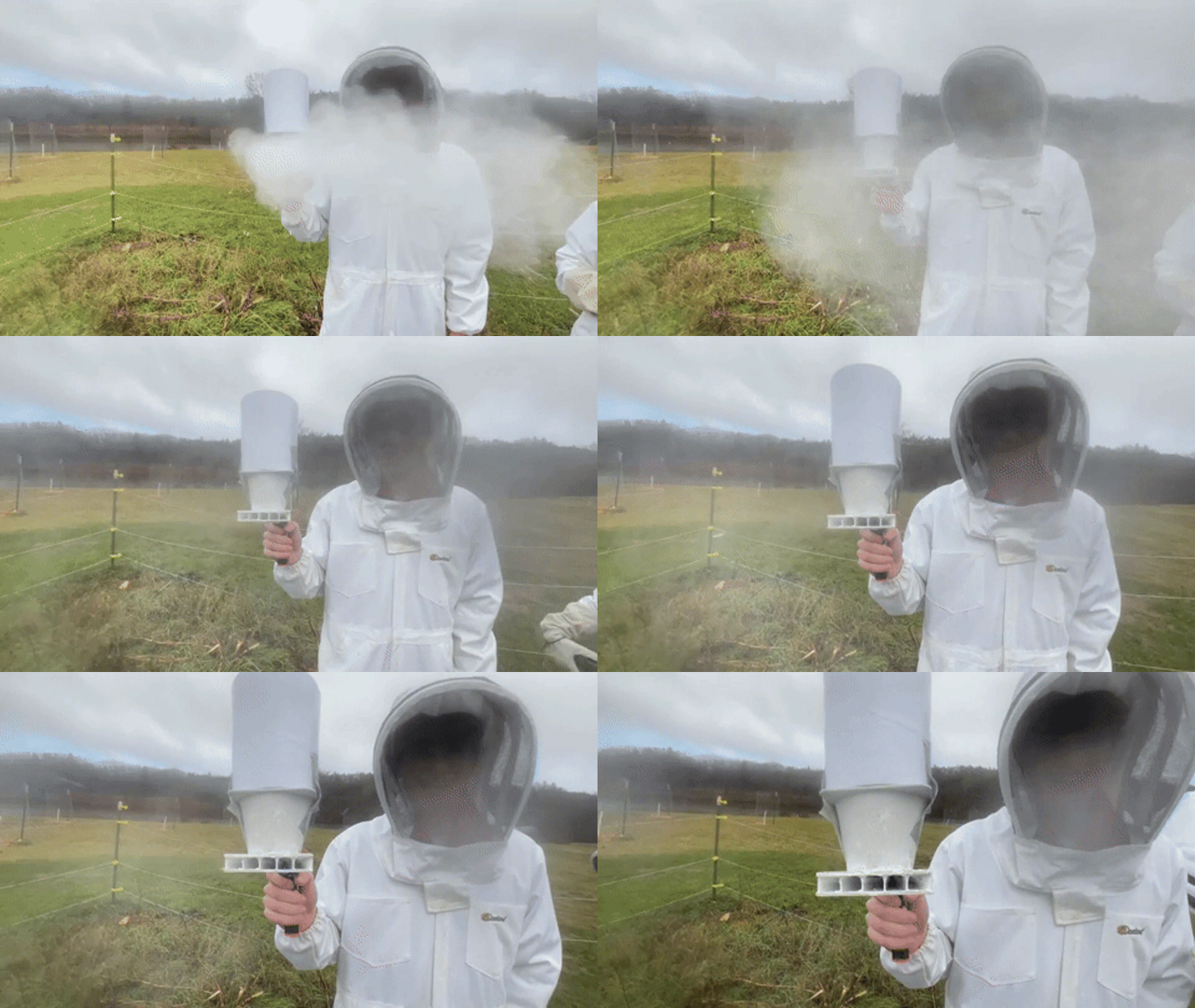

FreeBee treating a live hive at Dartmouth's Organic Farm
The beekeeper is me

Product Design · Agricultural Tools · 2025–Present

FreeBee

A handheld device that treats beehives for varroa mites using powdered sugar.

Varroa mites are collapsing honeybee colonies, and the chemicals that fought them are failing.

Varroa destructor is a parasitic mite that feeds on honeybees and spreads deadly viruses between them. It is the leading cause of colony collapse and resulted in the loss of over 60% of U.S. commercial colonies from 2024 to 2025, roughly 1.7 million hives and $600 million in damage (USDA-ARS, 2025).

Beekeepers fight the mite with the miticide amitraz, but it is losing effect. USDA found amitraz-resistance markers in essentially 100% of mites sampled from collapsed colonies. An organic treatment is desperately needed to protect the pollinators responsible for 1/3 of U.S. food supply.

A honeybee parasitized by Varroa destructor (circled)

Powdered sugar works. Applying it well is the hard part.

Dusting bees with fine powdered sugar is a proven, chemical-free treatment. The sugar coats the bees' fur, which triggers them to groom and lick it off each other, tearing the mites loose in the process. It leaves no residue, and mites cannot build resistance to it.

The problem is getting it onto a whole colony. The standard "sugar shake" lightly shakes 300 bees at a time inside a jar with sugar, but the average hive size is 30,000 to 40,000 bees. Dumping sugar over the frames gives slow and uneven coverage and forces the beekeeper to open the hive, which chills and disrupts the colony. Adapted leaf blowers and pest dusters do not meter a dose and clog as the sugar pulls in hive humidity.

Talking with working beekeepers confirmed the gap. They want a treatment that is fast, repeatable, chemical-free, and does not require opening the hive.

A first prototype to prove the treatment.

The first prototype had one job: quickly deliver a measured dose of powdered sugar without opening the hive. The dose is administered through a removable opening in an insert that is compatible with the standard hive. A motorized sifter de-clumps and meters the sugar, dropping it into a distribution chamber powered by a motorized blower to distribute across the brood box.

93%

Dose delivered

Held steady over repeated uses while a commercial duster clogged to 0%

3x

More even coverage

Than a commercial duster, measured by weighing sugar across a grid of the hive floor

11 seconds

Application time per hive

vs 5 minutes for commercial dusters

Lab measurements from an isolated hive-spacer test rig.

On a live colony at a local apiary, a single treatment produced a 1,700% increase in mite drop, with no observed swarming or disruption to the hive.

Turning a working proof into a real tool.

The first prototype proved the treatment works. The current version, funded by a Sayles Research Grant from Dartmouth's Ethics Institute, is about making it real.

I am building it from the ground up using raw electronics, a single-button control system, a motor-driven sifter and fan, and a consolidated 3D-printed housing. The goal is a sturdy, fully integrated, rechargeable device a beekeeper can rely on for daily use.

Version 2, in development


Back

All Work