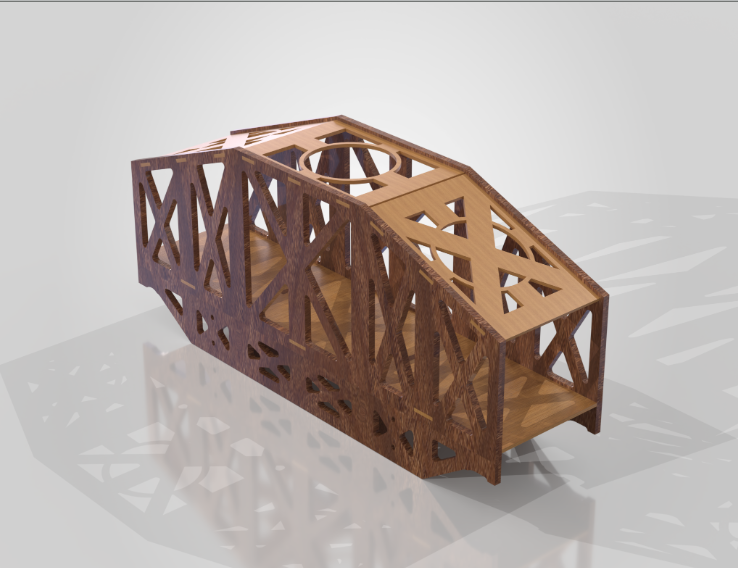
The finished birch-plywood truss bridge before testing

Structural Design & Fabrication · Summer 2026

Birch Truss Bridge

Designing, analyzing, and building a birch-plywood truss, then testing it to failure.

The strongest bridge for the least material.

The goal was simple to state and hard to do: design a birch-plywood truss that carries as much load as possible for as little weight as possible, then build it and test it to destruction. The design went through the full engineering process, from first sketches to a physical bridge loaded until it broke.

The finished truss weighed 0.6 kg and held 10.38 kN, roughly 1,700 times its own weight, the third-highest load in the class.

1,700×

Its own weight held

10.38 kN carried on a 0.6 kg bridge

0.6 kg

Total mass

Birch plywood, laser-cut and assembled

3rd

Highest load in the class

Tested to failure on an Instron

From sketch to a tested structure.

I worked through every stage of the design: researching truss forms and sketching concepts, modeling the geometry in SAP2000, developing the parts in SolidWorks under finite element analysis, then laser-cutting and hand-assembling the final bridge.

01 · Sketch

Researching truss forms and sketching concepts by hand.

02 · Analyze

Modeling the geometry and member forces in SAP2000.

03 · Refine

Developing the design in SolidWorks under finite element analysis.

04 · Fabricate

Laser-cutting the members from birch plywood.

Hand-assembling the final truss

Loaded until it broke.

The bridge was loaded on an Instron testing machine until failure. It carried 10.38 kN before giving way, and the break came at the crossmembers beneath the load points rather than in the truss itself, meaning the main structure never reached its own limit and the true capacity was higher still.

Failure at the crossmembers after Instron testing


Back

Lozorno Water Systems